A Framework for Understanding
the Development of Church Leaders
by John M. Elliott
Training leaders for the church is a challenging task, which cannot be considered in isolation by itself. Everywhere in the world the church exists in specific cultural contexts that have affected the church in a myriad of ways, including its understanding of itself. This subtab seeks to establish a framework in which the task of developing church leaders can be understood.
Part 1 considers the nature of the Church and its mission, as given to it by God and recorded in the Bible.
Part 2 goes on to look at the effects culture and tradition play in the unfolding of the Church's mission in a particular context.
Part 3 expands on this by considering how an individual local church can fulfill the Great Commission and "make disciples in all nations."
Part 4 concludes with a brief historical overview of how the Church has understood itself and its mission over the past 2000 years.
Part 1. Begin with a Biblical Understanding of the Church and Its Mission.
Most Christians come to know Christ in a particular church and over time absorb that local church's views without questioning them. Such basic questions as, “Is there a biblical model for what a local church should look like and be doing?” are rarely asked. People merely assume that the church they know and have been exposed to is the only way to organize a church, and all other churches have in some way “departed from the truth.” Those who look into the matter will learn that over the past two thousand years there have been widely differing views on what the Church is all about. This variety of understandings concerning the nature and mission of the church has played a key role the development of the wide variety of denominations in the world today.
While defining the nature of the Church and its mission seems rather basic and is
rarely discussed, it is crucial to one's understanding of local church leadership.
The primary function of church leadership should be to assist the church in fulfilling
its God-
As most people read the Bible, they unconsciously read it from where they stand, situated within a certain church context. They tend to see in the Bible what they expect to see and what they have been taught to see. This next section is an attempt to present what the Bible teaches concerning the Church and its mission in a summary fashion and hopefully will stimulate your thinking on this important issue.
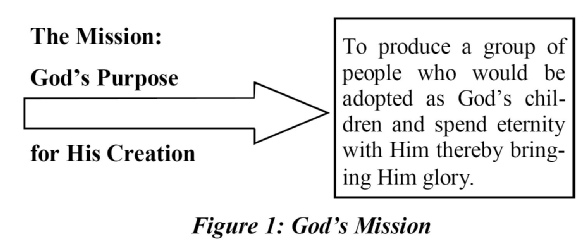
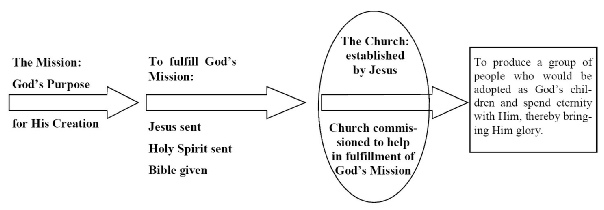
1. God's Mission. God's ultimate purpose in creating the world was to bring glory to Himself by producing a group of people who would choose to spend eternity with Him. God predetermined to adopt these people as His children and thus become a part of God's family. The Bible declares this to be God’s Mission, the goal of His work in creation.
Genesis 1. Man created in God's image, the only being on earth so created.
Ephesians 1:4-
Revelations 5:9-
2. God's Plan to Achieve His Goal. To achieve this product, God created man with
a free will—the ability to choose whether to serve God or not. God did this knowing
that man would choose to sin, thereby destroying man's original state of fellowship
with God (Genesis 3). God planned in advance to send his Son, Jesus, so that forgiveness
of sins and restoration of the relationship broken by man's sin could be offered
freely to all who desired it (John 3:16; Ephesians 1:4-
For this plan to be implemented, mankind must know of God's provision. How was the plan is to be made known to the peoples of the earth? God's plan called for the use of the church, those who had already received forgiveness of sins and eternal life, to become the carriers of the message. Thus, God has commissioned all those who have experienced his love and forgiveness to bear witness concerning this plan to those who have not yet heard.
3. Jesus Establishes the Church. Part of Jesus' mission was announced to be the establishment
of the Church (Matthew 16:18). While on earth, Jesus surrounded Himself with a band
of disciples who heard His teachings and watched Him put them into practice. These
disciples sought to imitate their Master by living lives in conformity to His teachings.
After dying for the sins of mankind and then appearing to His disciples to assure
them that all which was taking place was in accord with God's plan, Jesus commissioned
His disciples to spread the good news of God's plan to all peoples and make disciples
of all nations (Matthew 28:19-
Over the next few decades the Church developed from one small band of disciples in Jerusalem to hundreds of small bands of believers scattered across the eastern half of the Roman Empire and beyond. The New Testament gives us glimpses of this development, though it does not give us every detail.
4. The Nature of the Church. The English word “church” is used to translate the Greek
word “ecclesia.” The basic meaning of the word is “the called-
5. The Mission of the Church. God has commissioned the Church to join Him in His
mission—gathering a group of people who desire to become God's children and spend
eternity with Him. Local groups of believers become co-
Summary
In summary, God's plan in creating this world was to produce a family of adopted
sons and daughters who would spend eternity with him. Jesus came to the earth and
died for our sins, making it possible for those who wished to become children of
God. The future heavenly family of God is a body of people who are known as the “called-
Part 2. Be Aware of How Culture and Church Traditions
Affect This Understanding
Today the church has a rich history of almost two thousand years. Over that period of time the church's understanding of itself and its mission has gone through many changes. Two of the forces that have impacted the church's understanding of these two crucial areas are: 1) the culture in which each body of believers finds itself and 2) church traditions—both current traditions of other churches and church traditions developed long ago.
1. The Culture in Which a Local Church Exists. To effectively fulfill God's plan
it is necessary that the good news be packaged in a way that is understandable to
the peoples of the earth in their multitude of different cultures. Believers have
to carry the good news to peoples of cultures that are different from their own.
This initial penetration of the gospel into a new culture can be very difficult.
The New Testament pictures this process as the original group of Jewish believers
shared the gospel first with the Samaritans (Acts 8) and then with the Gentiles (Acts
10-
This danger is not new. The New Testament pictures the Early Church as responding
to such dangers. For instance, the Greeks viewed the human body as wicked while the
spirit was good. To those who believed this, it made no sense for God to become a
man. How could God, who is good, take on a wicked, sinful human body? In an attempt
to make Christian belief more acceptable to the Greeks some taught that Jesus was
not fully God while others taught that he only appeared to be a man. John writes
to condemn certain teachings and warns that certain ungodly spirits and false prophets,
claiming to be from God, were denying the fact that Jesus was a human being (1 John
4:2-
2. The Traditions of Other Churches and the Past. As a local church, or group of churches develop, certain ways of doing things become established. These practices soon become traditions. Many traditions of the church have their roots in the cultures of the past. Over time the culture outside the church may change but the traditions inside the church may not. For instance, the clerical robes many churches use were once the way all Europeans dressed. Sometimes the traditions become such an integral part of the church's way of doing things that these traditions are thought of as a part of the gospel. Jesus had many conflicts with the Pharisees over their traditions and whether they should be considered as having equal authority with the Old Testament Law. The Pharisees were greatly distressed when Jesus healed people and in so doing violated their traditional understandings of what a Jew might do on the Sabbath.
When the gospel is taken by believers to another culture, those believers often carry their traditions along with them as well. These traditions may prove to be unnecessary hindrances to the acceptance of the gospel by the new culture. For instance, the Early Church struggled over whether Gentiles had to obey the Jewish Law. The New Testament makes it clear that Jewish believers continued to be practicing Jews after accepting Jesus as their Messiah (Acts 21:20). But what about the Gentiles and the Law? This issue caused a deep division within the Church. In a major meeting in Jerusalem, at which all the church leaders participated, it was decided that Gentiles did not need to follow the Jewish traditions concerning the Mosaic Law (Acts 15).
When missionaries brought the gospel to Africa in the nineteenth century, they brought along with them the traditions that were being practiced in Europe and North America at the time. They built church buildings, established schools, and taught new believers to sing hymns. All these traditions, and many others, were treated as if they were integral parts of the gospel message and must be practiced by all Christians. This made it very difficult for Africans to become Christians, as they saw Christianity as very foreign. Missionaries sought to win them by encouraging younger Africans to come to their schools where they could be taught Western ways and Western languages. Eventually many Africans decided to become Christians, but only after they had accepted Western ways of doing things and looking at life.
Today it is common for Christians in Africa to be exposed to the practices and beliefs of Christians in other lands. Satellite television allows Africans to see how Christians in Australia worship God and to listen to preachers from around the world. The exposure to these different ways is in itself neither good or bad. But there is a danger that some practices may be copied without understanding the context in which they arose and, as a result, may be misapplied in the cultures of Africa. There is also the danger that a church in Africa may incorrectly assume that if they copy certain practices of successful churches in the West or elsewhere then their church will grow to be just like the successful church.
Ideally the activities of the church in every culture should be the same: sharing
the gospel, winning the lost, helping them grow in Christ, incorporating new believers
into local churches, and helping all believers play their God-
3. How These Can Affect the Church. As new believers come into the church they bring with them the attitudes and practices of the society in which they live. Where this does not affect the key elements of Christian doctrine, including the church's understanding of itself and its mission, there is no harm done. But frequently what is going on in society does affect the church in important ways. For instance, if the concerns and goals of society end up replacing the Mission God has given the local church. All societies have problems of various sorts. If society comes to see the church's role as primarily to help society right its wrongs and cure its ills, this attitude often ends up affecting the church's understanding of itself (see figure 3). The church may get heavily involved in politics. It may decide that eradicating poverty and providing employment is what the church is really all about. Many times these goals are good in themselves and represent activities the church should be involved in doing. But they are not the primary reason Jesus established the church. When the church accepts the mission society dictates instead of the Mission Jesus has given, the church will loose its way and cease being the salt and light it was meant to be.
Every local church has a past, which includes certain traditions. Even when a new
local body of believers starts, those who start it come from somewhere and they bring
their traditions with them. Most churches take in believers from other churches.
Each newly transferred believer brings with him or her the traditions of the church
they left. Traditions can be good. They tell us what to expect next and how things
are going to be done. Everyone uses their past experiences to assist them in facing
the challenges of today. Where challenges of past are like challenges of today, there
is a positive transfer and that is helpful. But when society is going through dramatic
changes, such as is happening in the world today, traditions can be harmful. Traditional
solutions to the problems of yesterday may not work in the world of today. When a
local church refuses to change and adapt to society around it, the church looses
its ability to impact society, and thus will also loose its ability to fulfill its
God-
The church needs to be constantly asking itself questions like these:
What is God doing today?
Are the ways we are doing things getting the mission done?
Are our leaders able to adjust to the changes around us? If not, what can be done about this?
Part 3. The Local Church—How It Can Fulfill Its Mission?
The first two parts have addressed the nature and mission of the Church in a general way. But the Church exists today as hundreds of thousands of local churches in a very complex world. The world has over 6,000,000,000 people who are organized in many thousands of different cultures and speak over 6,000 languages. Roughly 1/3 of the earth’s population call themselves Christians. Of the rest, about half, or about 2,000,000,000 people are believed yet to hear a clear presentation of the gospel in a way they can understand. The job of a local church is to fulfill Great Commission in its local context and see that the Great Commission is at the same time being fulfilled everywhere else in the world. In the face of this complexity and the size of the job ahead, how should the local church seek to fulfill its mission?
1. Reaching Your Local Cultural Group. Each local church is unique. The church is
people. No two people are exactly alike, and no two churches, even when they are
located in the same community, are exactly alike. Most urban communities are made
up of people from different cultural groups—they have different family and tribal
backgrounds, they are of different economic and educational levels, and they have
different goals and desires. These different cultural contexts mean that there is
a need for many different kinds of churches, each commissioned by Jesus to reach
a particular cultural group. A Russian-
Each church needs to begin by looking carefully and prayerfully at the location where God has placed it. Who lives around the church? Who is presently a part of the church? In what ways is the church like its community and in what ways is it different? It is very crucial that the leadership of an existing local church spends time before the Lord together in prayer until they are certain that they know exactly who it is that Jesus is asking them to reach for Him. That group becomes the local cultural target of that church. In most cases that will be the people who live within easy reach of the church and who are culturally similar to those already in the church. In the Zambian context, that would mean people who are of the same ethnic and economic background as the present church members. But that may not be what God is saying to the church leadership. And if God wants a local church to reach out to another group, that is who they should target to reach.
Once the target cultural group is identified, the church needs to determine how to reach that group. If a church is already growing and reaching the target group, it is probably already doing most of what it should be doing. But in many cases a local church is not really growing. People are won to Christ or join the church, but just as many leave and thus there is no net growth. Or perhaps almost all of the people joining a church are coming from other churches and very few are being won to Christ. If this is the case, the local church needs to seriously look at what it is presently doing and why. Everything needs to be examined. Some questions to consider:
1. What churches nearby with the same target group are growing? What are they doing differently than us?
2. Do the programs of our church help fulfill the church's mission? Are we investing a lot of time, energy, and money in activities that are unproductive?
3. Does our church have a clear focus or direction? Is this communicated to all the people in our church?
4. Do those who are workers in the church understand how their ministry contributes to the church's mission?
2. Nearby Cultural Groups (Nearby Either Geographically or Culturally). Besides the local cultural target group, every church has a responsibility before God to reach other people groups that are nearby. One way of describing these groups is to think of them as falling into one of two classes:
a. Those that are close culturally but live a distance from the church. These consist of people who are of the same target cultural group and would be relatively easy to reach for Christ, but they live too far away for them to attend your local church on a regular basis.
b. Those that are close geographically but distant culturally. These are people who
perhaps live in easy walking distance of your church, but it is unlikely that they
would feel comfortable in your church. The barrier maybe language, age, economic
level, or a number of similar things. In many cases you could change the way you
are doing things currently and make such a group feel comfortable, but in the process
you would make some of those currently attending the church feel uncomfortable. For
instance, if most of those currently attending your church are Bemba, probably most
of the choruses that are sung in church are Bemba and the sermon is translated into
Bemba for those who have trouble with English. This might make some Nyanja or Tonga
visitors feel out of place. But to change the language being used in services to
Nyanja might make some of the Bemba-
Probably the best way to address this matter is to plan on starting daughter churches to meet the needs of these other cultural groups. A healthy church should be able to start at least one other church every two to three years. In the case of the same target cultural group this can take the form of planting a new church like the mother church in a nearby village or on the other side of the town. In the case of groups which are close but are culturally distant, it can take the form of planting a new church very close by but geared to reach a group that is not presently being reached by your church. There may already be people in your church of this other cultural group, and they may feel at home there. But if it is apparent that most people of that cultural group would never seriously consider becoming members of your church because they do not feel like they belong, then perhaps a church planted specifically to reach this other cultural group may be what God desires your church to do.
3. Distant Cultural Groups. As noted at the beginning of this section, approximately 2,000,000,000 people today have not had a clear explanation of what God is offering mankind. Every local church, as a part of the body of Christ Jesus, has a responsibility to do what they can to make sure everyone alive today has a chance to hear about how much God loves them and what Jesus did for them at Calvary. Most of these 2,000,000,000 people live far away in countries where Christians cannot easily share their faith. But many of them do live in countries where they can be reached relatively easily by existing churches if they will listen to Jesus and earnestly seek to fulfill the Great Commission. The leaders of every church should seek to sensitize their members to the needs that exist in the world today. Some suggested courses of action:
a. Sensitize every believer to the need for evangelizing other peoples—those who have never heard the gospel.
b. Encourage believers to remember these unreached groups in prayer.
c. Seek to discover if some people who belong to these groups may not live very far away, within reach of your church.
d. Join together with other churches to support outreaches to these unreached peoples in other parts of the world.
Part 4. A Brief Historical Overview of the Church's Understanding
of Itself, Its Mission, and Church Leadership
The Early Church. Church leadership was God's idea, not man's, and Jesus personally
trained the Church's first leaders using Master-
As time went on and the church grew, other leadership positions developed. In Acts 6 the Apostles encouraged the believers to choose seven men, full of the Holy Spirit and wisdom, who could assume administrative responsibilities, thus freeing the Apostles to minister the Word and spend time in prayer. In time a body of elders is mentioned at the church in Jerusalem (Acts 11:30).
The New Testament does not describe clearly the nature of the leadership that existed
in the Early Church. It probably varied over time and also from place to place, being
guided by the Holy Spirit. Leaders were basically of two sorts, though there was
not a clear division between the two. Some leaders were itinerants who traveled widely,
planting churches and giving assistance where it was needed. People in this category
include Paul, Timothy, Agabus, and Titus. Many of these had certain spiritual gifts
which the Holy Spirit meant to be exercised throughout the church at large. Other
leaders were attached to a local church and seem to have only exercised their leadership
there. These leaders are collectively referred to as elders (Acts 20:17; Titus 1:5).
The New Testament also refers to deacons and overseers (bishops) as local church
leaders (Philippians 1:1; 1 Timothy 3:1-
The Rise of Roman Catholicism. After the close of the writing of the New Testament, further development in local church leadership occurred. Concern with persecution and dangerous false teachings led to a strengthening of the authority of local church leaders. A hierarchy developed among the local church leaders and the senior leader of the church in each city became known as the bishop. Early in the fourth century persecution of the church by the Roman government stopped and soon Christianity was declared to be the only official religion in the Roman Empire. This success came at a price, however. The government expected the church to speak with one voice and have a tightly controlled hierarchy that resembled that of the Roman government. Church and State basically became one at great cost to the nature and mission of the Church. The church became focused on governing those who had already accepted Christ and largely forgot about taking the gospel to the lost in the rest of the world. Over time the church gradually changed until it became what is known as the Roman Catholic and Eastern Orthodox churches. The church became a political organization which saw itself as the only representative of Jesus on earth. To be admitted into the membership of the Roman Catholic Church meant you were saved and would go to heaven. Salvation was based on membership in the Roman Catholic Church and receiving the sacraments, not on faith in Christ. To be expelled from the Roman Catholic Church meant you were lost and going to hell. In the process of all this change, the idea that the church had a mission was lost. The church came to see itself as an institution established and governed by God’s earthly representatives. Concern with fulfilling the Great Commission was all but lost.
The leader of a local church became known as a priest. This change in terminology reflected a change in the understanding of his duties. Instead of a concern for discipleship and equipping people for ministry, the priest saw himself as the only one authorized to perform ministry. His primary duty was serving as the mediator between God and the people. Only he could to celebrate the mass and change the wine and bread into the body and blood of Christ. Only he could administer the sacraments to those which the church had admitted, so that they could go to heaven.
The Protestant Reformation. During the twelfth to fifteenth centuries, many people realized that the Roman Catholic Church needed major reform. When the Roman Catholic Church proved unable to reform itself, a major rebellion against it broke out in northern Europe shortly after 1500, known as the Protestant Reformation. The two prominent figures in the Reformation were Martin Luther and John Calvin. Both were professors in universities where students were being prepared for the priesthood. In essence, the Protestant Reformation was a revolt born in the classroom by certain teachers and their students against the Church in Rome.
Both Luther and Calvin sought to strip away the many traditions that had developed in the Roman Catholic Church and return to the teachings of the New Testament. Salvation by faith in the work of Christ replaced salvation by receiving the sacraments and doing good works. The priesthood of all believers replaced the Catholic belief that a person had to approach God through a priest. Believers were encouraged to read the Bible for themselves instead of blindly accepting what the priest told them it contained. The central focus of a church services shifted from celebrating the mass to the delivery of a sermon prepared by the minister and based on the Bible.
Although great steps were taken in restoring Christianity to its New Testament form, many practices of the Roman Catholic Church continued to be observed. The division of believers into clergy and laity continued. The primary church leader was called a minister instead of a priest, but the congregation continued to view him as living on a higher level of spirituality than their own. The Reformation view of the Church and its mission continued to fall short of what the New Testament taught. While the Reformers taught that the Church was the fellowship of all the saints (those redeemed by God), the primary focus of the church's activities was seen as the correct observance of the Christian ordinances and correct preaching of the Word of God. There was little or no focus on evangelism, as people almost always came into the church through birth and everyone in a given locality belonged to the same church. Church and State continued to be viewed as one. There was no talk about fulfilling the Great Commission or reaching a lost world. During the sixteenth and seventeenth centuries Europe was split into Protestants and Catholics, and wars between the two sides were frequent. North and South America were only recently discovered and much of the Old World, tightly controlled by Islam, was antagonistic to Christianity.
Pietism, Revivals, and Protestant Missionaries. During the sixteenth and seventeenth
centuries Spain and Portugal dominated the world’s oceans. They spread the Roman
Catholic Church wherever they went. There was almost no Protestant missionary activity
during this period. The leaders of the Protestant reformation believed that the Great
Commission was given only to the Apostles and had been fulfilled by the spread of
the Early Church. During the seventeenth century, however, the Pietists and Puritans
were stirred by a desire to continue with much needed reforms in the Protestant churches.
Their stress on a personal experience with God by every believer led to a renewed
interest in the conversion of the lost and the spread of the church to distant lands
The spread of Pietism laid the foundation for a major revival that swept across England
and North America known as the Great Awakening (1725-
Methodism, Holiness, and Pentecostalism. One of the leaders of the Great Awakening was John Wesley. At first Wesley sought to bring about reform from within the Anglican Church, but eventually the followers of Wesley broke away and formed the Methodist Church. Wesley had been strongly influenced by the Pietists and this was reflected in many Methodist doctrines. The movement was extremely evangelistic and had grown to over one million Methodists by 1840. But by the middle of the nineteenth century Methodism itself was in need of revival, which led to the development of several groups that promoted personal holiness, based on the teachings of John Wesley. The meetings started what became known as the Holiness movement. This movement and its British counterpart, the Keswick Convention, prepared the ground for the rise of the Pentecostal movement of the twentieth century.
A Brief History of Protestant Theological Education. From the time of the Protestant
Reformation until the nineteenth century, most churches expected those desiring to
become church leaders to obtain a B.A. degree in liberal arts which was followed
by a period of theological study under a mature pastor. While many did not achieve
this level of education, it was the standard against which everyone was measured.
Baptists and Methodists, however, largely depended upon apprenticeships with existing
pastors for leadership training. Many of John Wesley's ministers did not have any
degree level of education and they were derisively called “unlearned.” Early in the
nineteenth century the period of theological study under a mature minister was replaced
by three years of study in a seminary. By the 1860s almost all denominations had
accepted the idea that ministers should have seven years of post-
The Holiness Movement and Keswick Convention brought revival to both sides of the
Atlantic during the late 19th century. Many of those saved were mature men and women
who desired to serve the Lord in full-
Summary
The church today exists in a complex world made up of thousands of cultures that are constantly changing. The church needs to reach all of these with a clear presentation of the Gospel and "make disciples" of all those who choose to respond to God's plan of salvation. These believers need to be formed into viable churches, who in turn can reach others.
To accomplish all this, the church needs to develop hundreds of thousands of new
leaders. How can be accomplished? I believe the proper place to start is by returning
to the Bible and reminding ourselves what we have been commissioned by Jesus Christ
to do. We need to come to grips with what is the Church and what is its mission.
Our understanding of the answer to these two crucial questions has been heavily colored
by almost two thousand years of traditions and the cultures through which the Gospel
has traveled on its way to us today. We cannot erase the effects of church history,
but we need to bear them in mind as we eye the situation we face today. There is
not going to be one answer to the question of how to train leaders who will take
the church forward into the twenty-
1. Who are we seeking to reach with the Gospel?
2. What kind of leaders will be needed to reach them for Christ?
3. How will we train them?
This subject will be addressed more fully under the "Questions" subtab.
| Us Pics |
| Land |
| People Languages |
| History |
| Christianity |
| Assemblies of God |
| Music |
| Food & Customs |
| CLTI |
| Adult Literacy |
| Newsletters |
| Leaders |
| Prayer |
| Page 19 |
| Page 20 |
| Page 21 |
| Page 22 |
| Pics 1998-2002 |
| Pics 2003-2008 |
| Pics 2009-2013 |
| Victoria Falls |
| National Parks |
| Animals |
| Miscellaneous |
| Websites |
| DMin Project |
| Framework |
| Concepts |
| Relationships |
| Questions |
| Concept 2 |
| Concept 3 |
| Concept 4 |
| Concept 5 |
| Concept 6 |
| Concept 7 |
| Concept 8 |
| Concept 9 |